
Gears
Gears in a manual car are an important mechanism that allow the car to be driven with the minimum strain on the car’s engine. Modern cars usually have five or six forward gears and one reverse gear, some older cars may just have four or five forward gears
A learner driver must be able to identify the correct timing for changing gear, and match the correct gear for the speed of the car. When changing gear its important that you don’t look down at the gear stick. You want to be looking forward, this will feel un-natural at first but with a bit of practice on your driving lessons you will soon get to grips with it.
Your driving instructor will teach you various methods on how to change up, as well a down the gears and also teach you how to identify when a gear change is necessary.
One helpful way of remembering the gear number locations is think odd numbers at the top and even numbers at the bottom.
Visualising the letter “H” may also help you remember where each hear is located.
Selecting Neutral gear
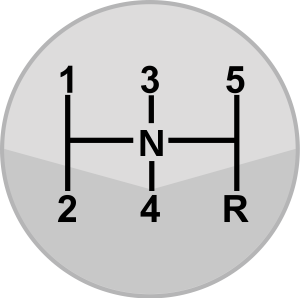
Neutral gear basically means NO GEAR. The cars gears have no connection with the engine. Neural is positioned below 3rd gear and above 4th gear.
You can identify that the car is in neural by giving the gear stick a wiggle from left to right and you should feel plenty of give in the lever.
Always ensure that the car is in neutral before starting the engine. If the car is in gear when you start the engine (and the clutch is up) then the car could lunge forwards or backwards. (see our FOOT CONTROLS page for more information)
An example of selecting 1st Gear
First ensure the car is in neutral, press clutch all the way down using your left foot.
To select first gear gently place your left hand onto the gear lever, palm down from you. Cup your hand around the gear lever and move it across to the left and then forward.
Be careful not to add unnecessary downwards pressure as in some cars this could engage reverse gear.
It’s important you are gentle with the gears – imagine that you’re holding a budgie! 🙂
1st gear is usually always the gear we use when moving forward from a stationary position. If the car is on a downhill gradient then 2nd gear can also be used.
Once you reach approximately 7-10mph then you can change to 2nd gear. Although, this speed depends on the type of car you are driving.
As a general guide to help you remember what gear you should be in for the speed, just add a ZERO to the gear. eg. 1st gear = 10mph, 2nd gear 20mph, 3rd gear 30mph. This is just a rough guide to initially help you get to grips with the gears. On your driving lessons you will learn to listen to the engine for when to change gear.
Selecting other gears
Lets assume your in first gear and you’ve reached your target speed for 2nd gear. Release the gas, press the clutch all the way down reach for the gear lever, bring the lever down in a straight line into 2nd gear.
Ensure that you are applying slight pressure to the left, this avoids the gear accidently slipping into 4th gear. If this happens then the car is likely to stall. To avoid this, we use a technique called “palming”. The palming method can be practiced on your driving lessons with your instructor.
Second gear is usually required when you reached a speed of 8-10mph (approx)
Changing from 2nd gear to 3rd gear, again a “palming technique” is best used, and a gentle, smooth upward action ( slightly diagonal) is needed otherwise you run the risk of selecting 5th or 1st gear by mistake, which could have dangerous consequences.
3rd gear tends to be the gear that most learner drivers initially struggle with. Don’t worry, your driving instructor will give you plenty of tips and advice on how to engage 3rd gear effectively
When changing from 3rd to 4th gear gently bring the lever downward (towards you) in a straight line, avoiding unnecessary pressure to the left or right.
Reverse gear is represented on the gearstick by the letter ‘R’. It may be in a different position depending on the model of car that you’re driving. Generally you either have to pull it up or push down to select reverse gear.
o 1st – Most powerful gear, we use it for moving of and performing maneuvers.
o 2nd & 3rd – These are the working gears, often used in traffic and town driving.
o 4th, 5th and 6th – cruising gears, often used at speeds above 30mph
o Reverse – used for maneuvers and moving backwards.
